
Interior Basement Waterproofing in Pickering
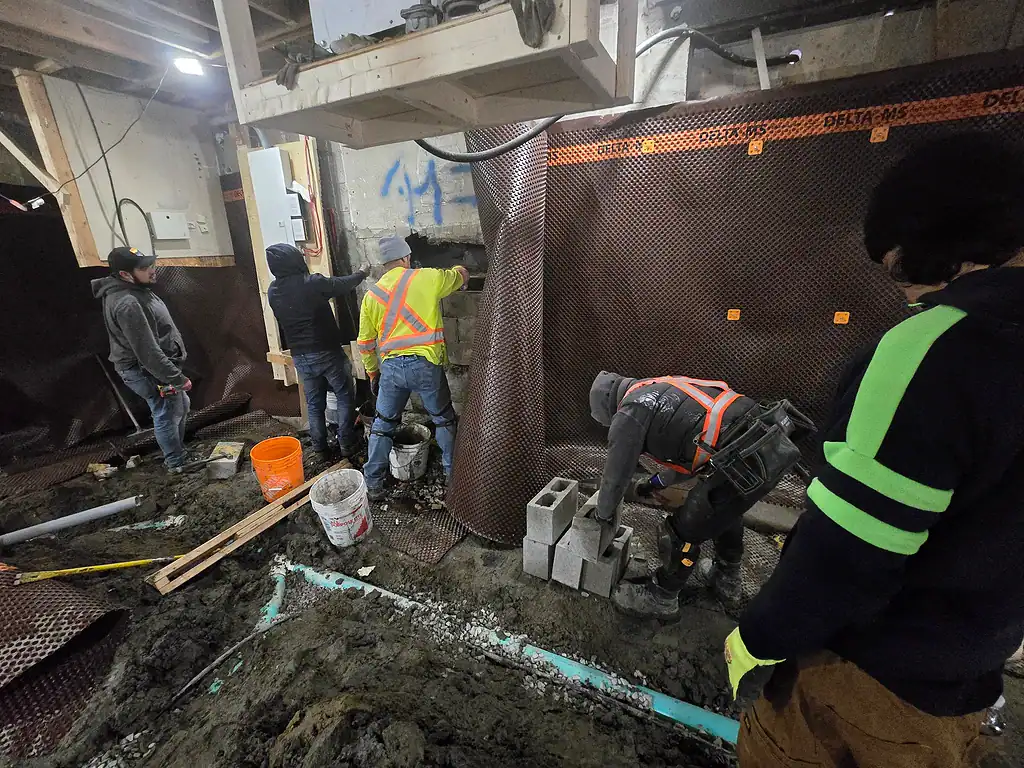
If you are dealing with a wet basement floor, recurring seepage along the base of your foundation walls, or a leak that appears every time it rains, interior basement waterproofing is often the fastest and most cost effective way to stop water from disrupting your Pickering home. Flood Tech Basement Waterproofing installs complete interior drainage and sump pump systems across Pickering, designed to manage water once it reaches the foundation, without the excavation a full exterior system requires.
What Is Interior Basement Waterproofing and Why It Matters?
Interior basement waterproofing is a water management system installed along the inside perimeter of a basement, designed to intercept water before it can pool on the floor or climb up the foundation wall. The process involves installing a drainage channel at the base of the interior foundation wall, connecting that channel to a sump pump, and directing the collected water safely out of the home.
For many homeowners, interior waterproofing is their first encounter with professional basement water management, often after years of managing minor dampness with a shop vac or portable dehumidifier. A properly installed drainage system removes the need for that ongoing manual effort entirely, handling water intrusion automatically and continuously rather than requiring intervention every time it rains.
Unlike exterior basement waterproofing, which stops water before it reaches the foundation wall, interior waterproofing manages water after it has already entered the wall assembly, collecting it at the source and moving it out before it can spread across the basement floor. This distinction matters because it shapes which situations each system is best suited for. Interior systems are typically faster to install, do not require excavation or disturbing landscaping, and can often be completed in a single day for an average sized basement.
The core principle behind interior waterproofing is interception and redirection. Rather than trying to keep every drop of water out of the foundation wall itself, an interior system accepts that some moisture will reach the wall and instead focuses on capturing it immediately at the floor to wall joint, before it ever has the chance to spread across a finished or unfinished basement space.
This approach reflects a practical reality about foundations: it is not always possible or economical to achieve a perfectly sealed exterior wall, particularly on older homes or properties where excavation access is limited. Interior waterproofing works with this reality rather than against it, providing a reliable, proven method of keeping a basement dry even when a perfect exterior seal is not achievable.
Why Interior Waterproofing May Be Required for Your Pickering Home
Interior waterproofing is often the right solution when a home’s landscaping, deck, patio, or driveway makes exterior excavation impractical or prohibitively expensive. It is also frequently chosen when the water intrusion is occurring specifically at the floor to wall joint rather than through the wall itself, since this is exactly the point an interior drainage system is designed to intercept.
Homeowners on a tighter timeline or budget often choose interior waterproofing as a faster path to a dry basement, since it avoids the cost and disruption of excavation while still providing reliable, long term water control. Interior systems are also a practical option for row houses, townhomes, and properties with shared walls where exterior access is limited or unavailable on one or more sides of the foundation.
In some cases, interior waterproofing is combined with targeted exterior repairs, such as addressing a single problem area or downspout discharge issue, rather than requiring full perimeter excavation. Our team can advise whether a purely interior approach, a purely exterior approach, or a combination gives you the most reliable long term result for your specific foundation.
Timeline is often the deciding factor for homeowners choosing between interior and exterior solutions. Exterior excavation depends on weather, ground conditions, and equipment scheduling, while interior work can typically be scheduled and completed within days regardless of the season. For a homeowner dealing with an active leak and limited patience for a multi week excavation project, interior waterproofing often represents the more practical near term solution, without sacrificing long term reliability.
Common Causes of Basement Water Problems in Pickering
- Hydrostatic pressure pushing groundwater up through the floor to wall joint
- A failed or missing exterior weeping tile system no longer draining properly
- Poor exterior grading directing surface water toward the foundation
- Cracks in the basement floor slab allowing water to seep through
- Condensation on cold basement walls being mistaken for active leaking
- A sump pump that has failed or was never installed
- Clay heavy soil that retains moisture and expands seasonally
- Aging foundation walls with a deteriorated original waterproofing coating
Many Pickering basements experience water intrusion specifically at the cove joint, the seam where the foundation wall meets the floor slab, since this is naturally one of the most vulnerable points in a foundation’s construction. Understanding this pattern is part of why interior systems are designed the way they are, with the drainage channel positioned precisely at this joint rather than higher up the wall.
Signs You Need a Wet Basement Waterproofing Specialist in Pickering
A wet basement rarely happens without warning. Watch for:
- Water seeping along the base of the wall where it meets the floor
- Puddles forming on the basement floor after rain or snowmelt
- A white chalky residue known as efflorescence on walls or floor
- A musty smell that persists despite cleaning and ventilation
- Visible mold growth along baseboards or the lower portion of walls
- Rust stains or corrosion on items stored directly on the basement floor
- Warped or lifting flooring in a finished basement
- A sump pump that runs constantly or not at all during wet weather
If your Pickering basement is showing signs of water intrusion primarily at floor level, along the cove joint, or in a pattern that follows specific weather events, this is one of the clearest indicators that an interior drainage system is an appropriate solution.
Inspection and Assessment for Pickering Properties
Every interior waterproofing project starts with a full inspection of your Pickering basement, identifying exactly where and how water is entering. Our technicians examine the floor to wall joint, check for cracks in the slab, assess the condition and function of any existing sump pump, and determine whether the water pattern suggests hydrostatic pressure, surface drainage issues, or a combination of causes.
We also evaluate whether the basement is finished or unfinished, since this affects how the interior drainage channel is installed and whether any existing flooring or framing will need to be removed along the perimeter to access the floor slab. Every inspection concludes with a written summary and a clear, itemized recommendation, so you understand exactly what the project involves before committing.
Top Rated Interior Waterproofing Solutions Available in Pickering
Depending on what the inspection reveals, our team offers several interior waterproofing approaches.
- Full perimeter interior drainage system: a complete drainage channel installed along the entire interior floor to wall joint, connected to a sump pump
- Spot interior drainage: a targeted drainage solution addressing a specific problem area rather than the full perimeter
- Sump pump installation or replacement: installing a new or upgraded pump as part of the overall drainage system, coordinated with our sump pump services team
- Foundation crack injection: sealing individual cracks in the wall or floor with polyurethane or epoxy injection
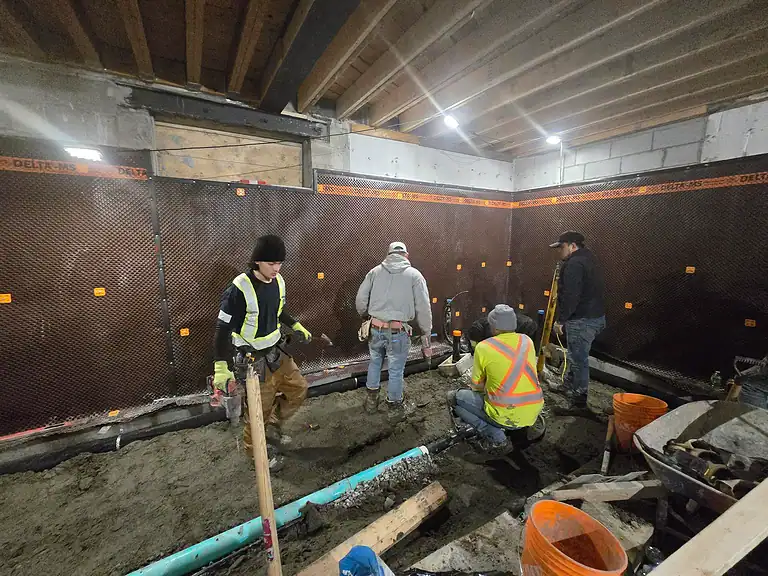
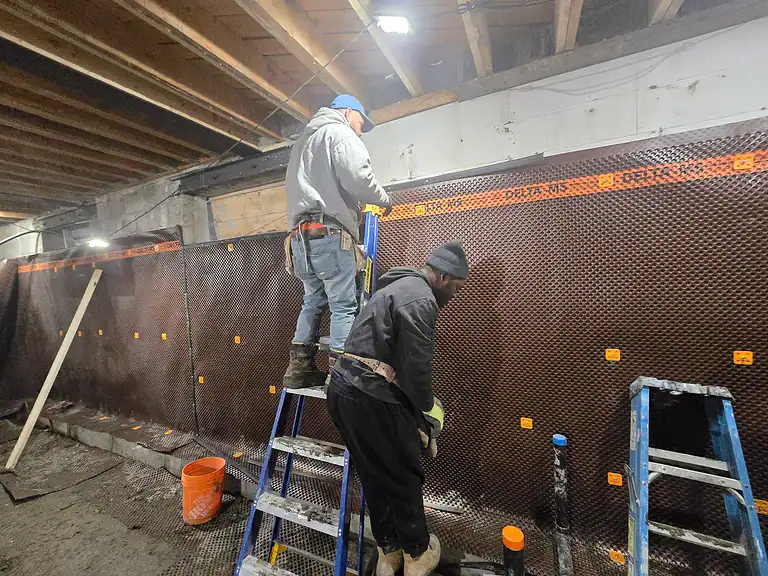
- Wall membrane and dimple board application: installing a protective drainage membrane on interior foundation walls to direct water down to the drainage channel
Our Interior Waterproofing Process in Pickering
Step 1: On Site Inspection and Assessment
We begin with a free, thorough inspection to identify the water entry pattern and determine the right scope of work for your basement.
Step 2: Floor Perimeter Excavation
A narrow trench is cut and excavated along the interior perimeter of the basement floor, exposing the footing and floor to wall joint where the new drainage channel will be installed.
Step 3: Drainage Channel Installation
A perforated drainage pipe is installed in the trench along the footing, positioned to intercept water at the exact point it typically enters, then covered with washed stone to maintain proper drainage flow.
Step 4: Wall Membrane Application
Where recommended, a dimple board or drainage membrane is installed along the base of the interior wall to direct water down into the new drainage channel rather than allowing it to seep across the floor.
Step 5: Sump Pump Installation
The drainage channel is connected to a sump pit and pump, which collects the water and discharges it safely away from the home’s foundation.
Step 6: Concrete Restoration
Once the drainage system is installed and tested, the excavated trench is filled and the concrete floor is restored along the perimeter, leaving a clean, finished surface.
Step 7: System Testing and Warranty Documentation
The completed system is tested to confirm proper drainage and pump function, and written warranty documentation is provided for your records.
Materials and Systems Used in Pickering Interior Waterproofing
- Perforated drainage pipe designed for interior basement applications
- Washed clear stone for drainage channel backfill
- Dimple board or drainage membrane for wall application
- Submersible sump pumps sized to the property’s drainage needs
- Battery backup sump pump systems for power outage protection
- Polyurethane or epoxy injection material for crack sealing
The specific combination of materials depends on the basement’s construction, the severity of the water issue, and whether the space is finished or unfinished. We select components built for long term reliable performance rather than the cheapest available option.
How Much Does Interior Basement Waterproofing Cost in Pickering?
Interior waterproofing costs depend primarily on the linear footage of drainage channel being installed, whether a new sump pump and pit are required, whether the basement is finished and requires additional restoration work, and whether any foundation crack injection is needed alongside the drainage system.
As a general reference, interior waterproofing across the industry typically runs somewhat less per linear foot than full exterior excavation, often in a range of roughly 50 to 100 dollars per linear foot, depending on scope and site conditions, with sump pump installation typically adding a separate flat rate to the total project. These figures are for general orientation only. Every basement receives its own detailed, written estimate after inspection, with no hidden fees added once work begins.
Homeowners comparing interior and exterior waterproofing quotes should keep in mind that these figures are not directly comparable on a linear foot basis alone, since the two approaches involve fundamentally different scopes of work. An interior system’s cost is driven primarily by drainage channel length and pump requirements, while an exterior system’s cost is driven by excavation depth, soil conditions, and site access. The right comparison is not simply which number is lower, but which approach actually resolves the specific water intrusion pattern identified during inspection.
Best Time of Year for Interior Waterproofing in Pickering
Unlike exterior waterproofing, interior systems can generally be installed year round, since the work takes place entirely inside the basement and is not affected by frozen ground or excavation equipment access. This makes interior waterproofing a practical option for homeowners who discover a wet basement during the winter months and do not want to wait for spring to address it.
That said, scheduling promptly after noticing warning signs is still the best approach, since a basement that has already been experiencing water intrusion for an extended period is more likely to also need mold remediation or additional cleanup alongside the waterproofing itself.
Interior Waterproofing for Finished and Unfinished Basements in Pickering
The condition of a basement significantly affects how an interior waterproofing project unfolds. In an unfinished basement, installation is relatively straightforward, since the concrete floor is fully accessible and no flooring, drywall, or framing needs to be removed before work begins. Once the drainage channel is installed and the concrete restored, the space is ready for immediate use.
Finished basements require additional planning. Flooring, baseboards, and in some cases a section of drywall along the work area need to be removed to access the floor slab, and homeowners should budget for restoring these finishes after the waterproofing work is complete. Our team walks through this scope in detail during the inspection, including which materials will need to come out and what restoration options are available, so there are no surprises once the project begins. In many cases, only the flooring and trim directly along the perimeter wall need to be disturbed, leaving the rest of the finished space untouched.
How an Interior Drainage System Actually Stops Water in Your Pickering Home
It helps to understand the physics behind why an interior drainage system works as reliably as it does. Water entering a basement almost always follows the path of least resistance, and in most foundations that path leads to the cove joint, the seam where the vertical foundation wall meets the horizontal floor slab. This joint is rarely perfectly sealed, even in newer construction, which makes it the most common point of water entry regardless of a home’s age.
By installing a drainage channel directly at this joint, positioned slightly below the floor slab level and sloped toward the sump pit, an interior system intercepts water at the exact point it is most likely to enter, before it has the chance to spread across the floor. The washed stone surrounding the drainage pipe allows water to move freely into the pipe while filtering out fine soil particles that could otherwise clog the system over time. This combination of correct positioning, proper slope, and appropriate backfill material is what separates a system that performs reliably for decades from one that fails prematurely.
Best Basement Waterproofing Contractor Specialist in Pickering
Interior waterproofing is a precise trade, and the quality of the installation matters as much as the materials used. Our crews take care to position the drainage channel at the correct depth and slope, ensuring water actually flows toward the sump pit rather than pooling in low spots along the channel.
We do not treat sump pump selection as an afterthought. A pump undersized for the property’s drainage needs will struggle during heavy rain, while a pump without battery backup leaves a home vulnerable during a power outage, often the exact moment a sump pump is needed most. Our team sizes and specifies equipment based on the actual demands of your basement, not a one size fits all default.
Every interior waterproofing system we install is backed by written warranty documentation. We also perform in house work with trained crews rather than subcontracting the installation, keeping the same team accountable from inspection through final testing.
Important Considerations Before Starting Interior Waterproofing in Pickering
Interior waterproofing involves cutting into the existing concrete floor along the basement perimeter, which means finished basements will need flooring, baseboards, and sometimes framing removed along the work area before installation begins. Our team discusses this scope clearly during the inspection so there are no surprises once work is underway.
It is also worth understanding that interior waterproofing manages water that has already reached the foundation, but does not stop water from reaching the wall itself. If the underlying cause is a failed exterior weeping tile system or a significant grading issue, addressing that source, potentially alongside exterior waterproofing, may provide a more complete long term solution depending on the severity of the problem.
A functioning sump pump is central to how an interior system performs, which means ongoing electrical reliability matters. Homes in areas prone to power outages should strongly consider a battery backup system as part of the installation, since a drainage channel with no way to discharge collected water will simply refill the sump pit until it eventually overflows.
Homeowners should also plan for periodic sump pump testing as an ongoing responsibility once the system is installed. Unlike an exterior waterproofing membrane, which requires essentially no maintenance once backfilled, an interior system includes a mechanical component that benefits from occasional attention to confirm it remains ready to perform when the next heavy rain or spring thaw arrives.
Benefits of Interior Basement Waterproofing for Pickering Homes
- Faster installation than exterior systems, often completed in a single day
- No excavation, preserving landscaping, decks, and hardscaping
- Effective for water entering specifically at the floor to wall joint
- A practical option when exterior access is limited or unavailable
- Generally lower cost than full perimeter exterior excavation
- Backed by a written warranty for lasting peace of mind
- Can be installed in any season, without waiting for suitable ground conditions
Risks of Ignoring a Leaky Basement in Pickering
A wet basement rarely stays a minor inconvenience if left unaddressed. Sustained moisture creates ideal conditions for mold growth, damages flooring, drywall, and stored belongings, and can eventually affect framing in contact with damp concrete. A sump pump left unmonitored, without a backup system, can fail at exactly the wrong moment, allowing a manageable amount of water to become a significant flood.
For Pickering homeowners planning to sell, a history of basement water intrusion discovered during a home inspection can complicate negotiations and reduce buyer confidence, even when the underlying issue would have been a relatively affordable fix. In more severe cases, prolonged water exposure can require basement water removal and additional cleanup that represents a considerably larger investment than addressing the problem with a properly installed drainage system from the start.
Maintaining Your Pickering Interior Waterproofing System
A properly installed interior drainage system requires only modest ongoing attention. Testing the sump pump periodically, particularly before spring thaw and heavy rain seasons, confirms it is ready to perform when needed. Keeping the sump pit free of debris and checking that the discharge line outside the home is clear and unobstructed helps the system continue working as intended.
Homeowners should also pay attention to unusual sump pump sounds, a pump that runs constantly, or one that does not activate during clearly wet conditions, since these can be early signs of a developing mechanical issue worth addressing before it becomes a failure during a major storm. A brief visual check of the discharge line each spring, confirming it is not blocked by debris, ice, or settled soil, is another simple habit that helps the system continue performing reliably year after year.
Interior Waterproofing Compared to Other Wet Basement Solutions in Pickering
Homeowners often compare interior waterproofing to exterior basement waterproofing, which addresses water before it reaches the foundation wall rather than after. Exterior systems are generally considered more permanent since they remove hydrostatic pressure at the source, but they require excavation, which is not always practical or affordable for every property. Interior systems offer a faster, less disruptive alternative that performs very well for water entering at the floor to wall joint specifically.
For an isolated crack without broader signs of water intrusion, foundation crack injection alone may resolve the issue without a full drainage system. For basements with a longstanding history of leaking despite previous attempted repairs, our basement leak repair team can help identify the true underlying cause before recommending the most appropriate long term fix.
Some homeowners ultimately choose to combine both approaches, particularly when a foundation shows signs of both wall related seepage and floor level water intrusion. In these cases, exterior waterproofing addresses the pressure against the wall while an interior drainage system provides a secondary layer of protection at the floor to wall joint, giving the most comprehensive coverage available for a basement with a more complex water intrusion history.
Serving Pickering Homeowners With Wet Basements
Flood Tech Basement Waterproofing installs interior drainage and sump pump systems for homes throughout Pickering and the Greater Toronto Area, from older neighborhoods with original stone and brick foundations to newer subdivisions built on clay heavy soil. Our crews understand the seasonal patterns, from spring thaw to summer storms, that put the most demand on a home’s drainage system.
Whether your basement needs a full perimeter drainage system or a targeted repair for a specific problem area, our team brings the same thorough inspection process and honest, written recommendations to every property we assess. From detached homes to townhomes with shared walls, our crews adapt the installation approach to whatever layout and access constraints your property presents.
Pickering Interior Basement Waterproofing FAQs
How long does interior basement waterproofing take?
Most interior waterproofing projects in Pickering are completed within 1 to 3 days, depending on the length of drainage channel being installed and whether sump pump work is included.
Will interior waterproofing damage my finished basement?
Installation requires removing flooring and baseboards along the perimeter work area. Our team discusses this scope during the inspection and can advise on restoration options afterward.
Do I need a sump pump for interior waterproofing to work?
Yes, the drainage channel needs somewhere to send the collected water, and a properly sized sump pump is a core part of a functioning interior waterproofing system.
Can interior waterproofing be installed in winter?
Yes, since the work takes place inside the basement, interior waterproofing can generally be installed year round, unlike exterior excavation which depends on ground conditions.
What happens if my sump pump fails after installation?
We recommend a battery backup system specifically to protect against pump failure during power outages. If a pump issue does arise, our team is available to service and repair it.
How much does interior waterproofing typically cost?
Costs generally run somewhat less per linear foot than exterior excavation, though sump pump installation adds to the total. Every property receives its own detailed, written estimate after inspection.
Do you offer a warranty on interior waterproofing work?
Yes, all interior waterproofing systems installed by our team come with written warranty documentation.
What to Look for When Choosing the Best Interior Waterproofing Contractor in Pickering
Interior waterproofing looks straightforward on the surface, but the quality of installation varies significantly between contractors. Use this checklist before hiring anyone to work on your basement.
- Correct channel slope and positioning: ask how the contractor ensures water actually drains toward the sump pit rather than pooling
- Sump pump sizing, not just installation: a reputable contractor explains why a specific pump size and battery backup option is recommended for your basement
- Licensing and insurance: confirm proper liability insurance coverage before any work begins
- Direct employees performing the work: ask whether the installation crew are trained employees or outside subcontractors
- Named materials and components: a trustworthy estimate specifies the actual drainage pipe, pump model, and membrane being used
- Written, transferable warranty: insist on documentation that also transfers to a future homeowner
- Concrete restoration included: confirm the quote includes properly restoring the floor after the trench is filled, not just the drainage installation itself
- Verifiable local experience: ask for references or examples of similar interior waterproofing projects
Be cautious of any quote significantly lower than others you have received, since this often signals a thinner drainage pipe, an undersized sump pump, or skipped wall membrane application. The best basement waterproofing contractor for your home provides a transparent, itemized plan and stands behind it with a warranty you can actually enforce, not simply the lowest number on paper.
Get a Free Estimate From Pickering’s Trusted Waterproofing Company
Do not let a wet basement disrupt your Pickering home any longer. Our Pickering team provides free inspections and honest recommendations backed by a written warranty.
416-900-7524
Call for a Free Inspection